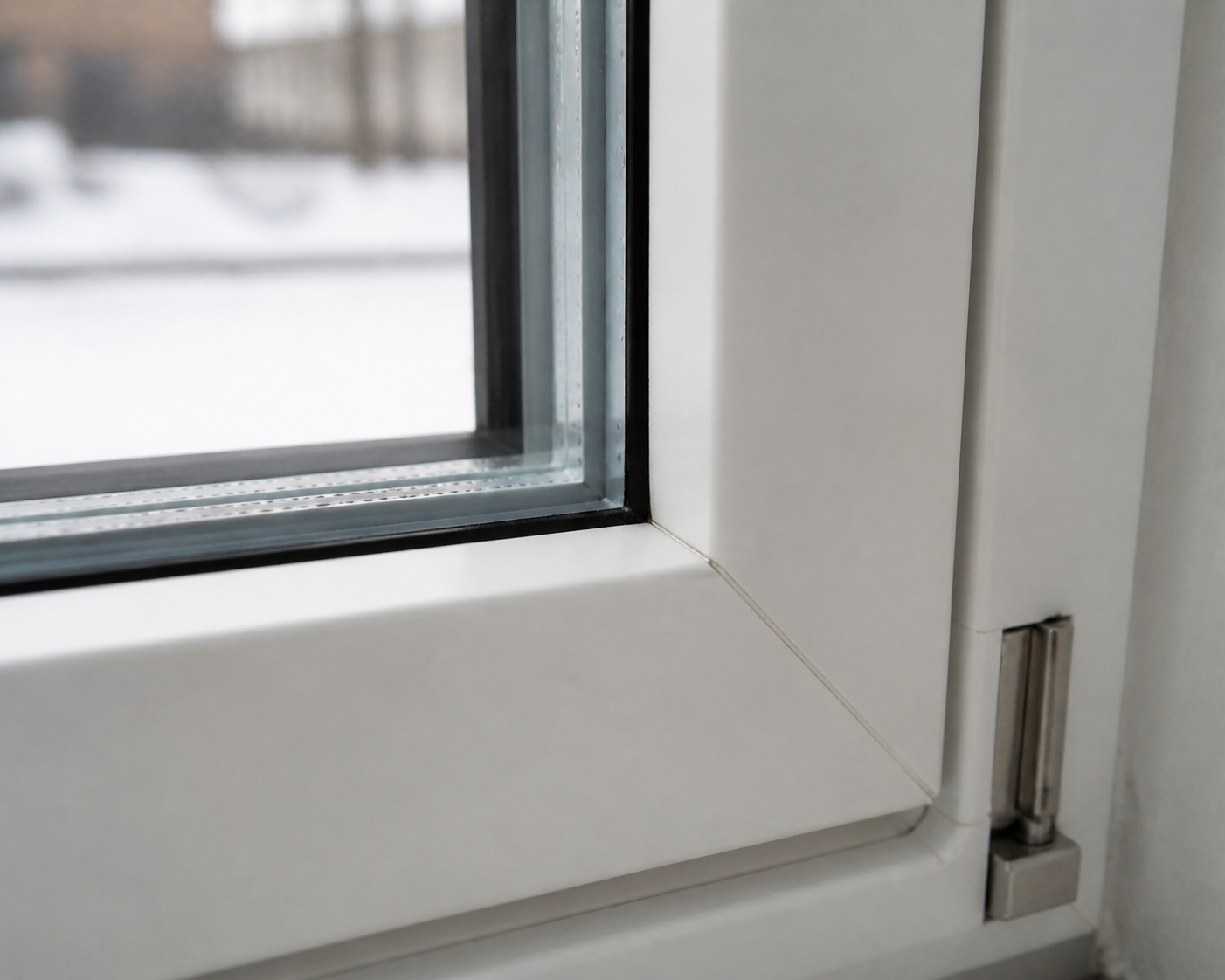
Windows are one of those parts of a house almost nobody thinks about until something goes wrong — a draft that will not quit, condensation fogging the glass, a heating bill that keeps creeping up, or a frame that has started to swell and stick. And when people finally do start looking into replacements, they run headfirst into a word they have heard a thousand times but never really examined: vinyl.
Vinyl windows are, by a wide margin, the most common replacement windows installed in Canadian homes today. That popularity breeds a lot of half-truths. Some folks assume “vinyl” means cheap. Others confuse it with the soft, floppy material in an old record or a kitchen floor. Still others lump it in with the flimsy plastic of a disposable water bottle. None of that is accurate, and the gap between what vinyl windows actually are and what people assume they are is exactly the gap this article is written to close.
This is a long read on purpose. We wanted to put together one thorough, honest resource — not a sales pitch — that walks through the history, the science, the real-world performance, the anatomy of the product, and the practical realities of installation. Grab a coffee. By the end you will understand vinyl windows better than most people who sell them.
A Quick Word About Who We Are
Before we get into the material itself, a brief introduction so you know where this is coming from. WindowFixers.ca is a family-owned window company based in Newmarket, Ontario. We supply and install custom vinyl windows for homes and commercial properties across the Greater Toronto Area, north through York Region and up to Barrie and Simcoe County.
We are not a manufacturer and we do not pretend to be. What we do is help homeowners choose the right windows, measure every opening precisely, order units built to those exact measurements, and install them properly with our own crew. Over more than a decade we have handled everything from a single foggy picture window to whole-home replacements on two-storey houses, and most of that work has come through referrals and repeat customers.
We mention this only because it shapes the tone of everything below. We spend our days answering the same practical questions from real homeowners, so this guide is written the way we would explain things across a kitchen table — straight, detailed, and without trying to talk you into anything. If a fact is inconvenient, we will still tell you.
Why Vinyl? The Bigger Picture
To understand why vinyl came to dominate the window market, it helps to remember what people were replacing. For most of the twentieth century, residential windows were made of wood or, later, aluminum. Both materials have real virtues, and both have real problems that vinyl was specifically developed to solve.
A short history of the window frame
Wood is the traditional choice, and for good reason: it is beautiful, it insulates reasonably well, and a skilled carpenter can shape it into almost anything. But wood is also alive in a sense — it absorbs and releases moisture with the seasons, which means it swells, shrinks, warps, and eventually rots if it is not vigilantly maintained. A wooden window that is not scraped, primed, and repainted every few years will not last. In a climate like Ontario’s, with brutal freeze-thaw cycles and swings from humid summers to bone-dry winters, that maintenance burden is relentless.
Aluminum arrived mid-century as a modern, industrial alternative. It is strong, it is dimensionally stable, and it can be extruded into slim, clean profiles. Unfortunately, aluminum is also an outstanding conductor of heat. An aluminum frame pulls warmth straight out of your home in winter and lets it pour in during summer. Early aluminum windows were notorious for interior condensation and frost forming on the frame itself, because the metal carried the outdoor cold directly to the inside surface. Thermal breaks improved this, but the fundamental physics never went away.
Vinyl — more precisely, rigid polyvinyl chloride, which we will unpack in the next section — was developed for window frames in Europe after the Second World War, with Germany leading much of the early engineering during the post-war rebuilding boom and the energy crises of the 1970s. Europeans, facing high energy costs and a desire for low-maintenance housing, embraced rigid vinyl frames decades before North America did. The material offered a combination that neither wood nor aluminum could match: it does not conduct heat readily, it does not rot or corrode, and it never needs painting.
How vinyl took over North American homes
Vinyl windows arrived in North America in earnest during the late 1960s and 1970s and steadily gained ground through the 1980s and 1990s as manufacturing quality improved and energy codes tightened. Two forces drove the takeover. The first was economics: vinyl frames are less expensive to produce than well-made wood windows, and they arrive essentially finished, with no painting or staining required. The second was performance: as governments introduced energy-efficiency standards and homeowners started paying attention to heating and cooling costs, the insulating properties of a hollow, multi-chambered vinyl frame became a genuine selling point rather than a technical footnote.
Today, vinyl is the default material for replacement windows across Canada and the United States. It is not that wood and fibreglass and aluminum have disappeared — they each still have their place, and premium wood windows remain gorgeous — but for the typical homeowner who wants strong energy performance, a long service life, and freedom from maintenance at a sensible price, vinyl checks every box. That is why it now accounts for the large majority of residential window sales.
In practice, that dominance means vinyl is now the material a homeowner encounters by default. Walk down almost any residential street built or renovated in the last thirty years and the great majority of the windows you see — white or almond frames, clean sightlines, sliding or crank operation — are vinyl. The supply chain matured around it: profiles are extruded in consistent, well-tested shapes; hardware is standardized and widely available; and manufacturers can turn a set of custom measurements into a finished, made-to-order window in a matter of weeks. That maturity is part of why vinyl is so accessible. It is not an exotic or specialty product; it is the mainstream, with all the reliability and choice that a mature market brings.
The ecology question, answered honestly
It would be dishonest to write about vinyl without addressing its environmental reputation, which is genuinely mixed and deserves a fair hearing rather than a sales-brochure gloss. PVC is a petroleum-derived plastic, and its manufacture is energy-intensive. Those are real costs, and we are not going to wave them away.
That said, the full picture is more nuanced than “plastic bad.” The single largest environmental impact of a window over its lifetime is not the frame material — it is the energy the window either saves or wastes, year after year, for decades. An old, leaky, single-pane window bleeds heated and cooled air continuously. Replacing it with a well-sealed, Low-E, gas-filled vinyl unit can meaningfully cut the energy your furnace and air conditioner have to burn, and that operational saving typically dwarfs the embodied energy of the frame within a handful of years.
There is also the durability argument. A vinyl window that lasts thirty or forty years without rotting, without needing repainting, and without being sent to landfill for replacement is, in lifecycle terms, doing better than a product that has to be refinished repeatedly or replaced early. And rigid PVC is recyclable — the material can be reground and reused, and a growing number of manufacturers reclaim production offcuts and end-of-life frames. It is not a perfect closed loop yet, but it is far from the throwaway plastic people imagine.
The honest summary: vinyl is not a “green” product in the way a reclaimed timber frame might claim to be, but over a real service life its energy savings and longevity make it a defensible, often favourable, environmental choice — especially compared to leaving old, inefficient windows in place.
What “Vinyl” Actually Means (Clearing Up the Confusion)
Here is where more misunderstanding lives than anywhere else in the window world. The word “vinyl” gets attached to a huge range of products — flooring, records, banners, upholstery, siding, fencing, and windows — and because those products feel so different in the hand, people assume they must be loosely related at best. So let us be precise about what vinyl windows are and, just as importantly, what they are not.
No, it is not soft — and it is nothing like linoleum
When many people hear “vinyl” they picture something flexible: a vinyl record that bends, a vinyl floor tile you could roll up, a soft vinyl seat cushion. Those products are made from plasticized PVC — polyvinyl chloride that has had softening chemicals called plasticizers added specifically to make it bendable.
Window frames are made from something quite different: rigid, unplasticized PVC, commonly labelled uPVC (the “u” stands for unplasticized). No softeners are added. The result is a hard, structural material that holds its shape under load, does not sag, and does not flex like a floor tile. If you rap your knuckles on a vinyl window frame it feels solid and firm — much closer to a hard composite than to anything soft. It is emphatically not linoleum, which is a completely different material made largely from linseed oil and cork dust and has nothing to do with window frames beyond an unfortunate shared association with the word “vinyl” in everyday speech.
And no, it is not “cheap plastic” either
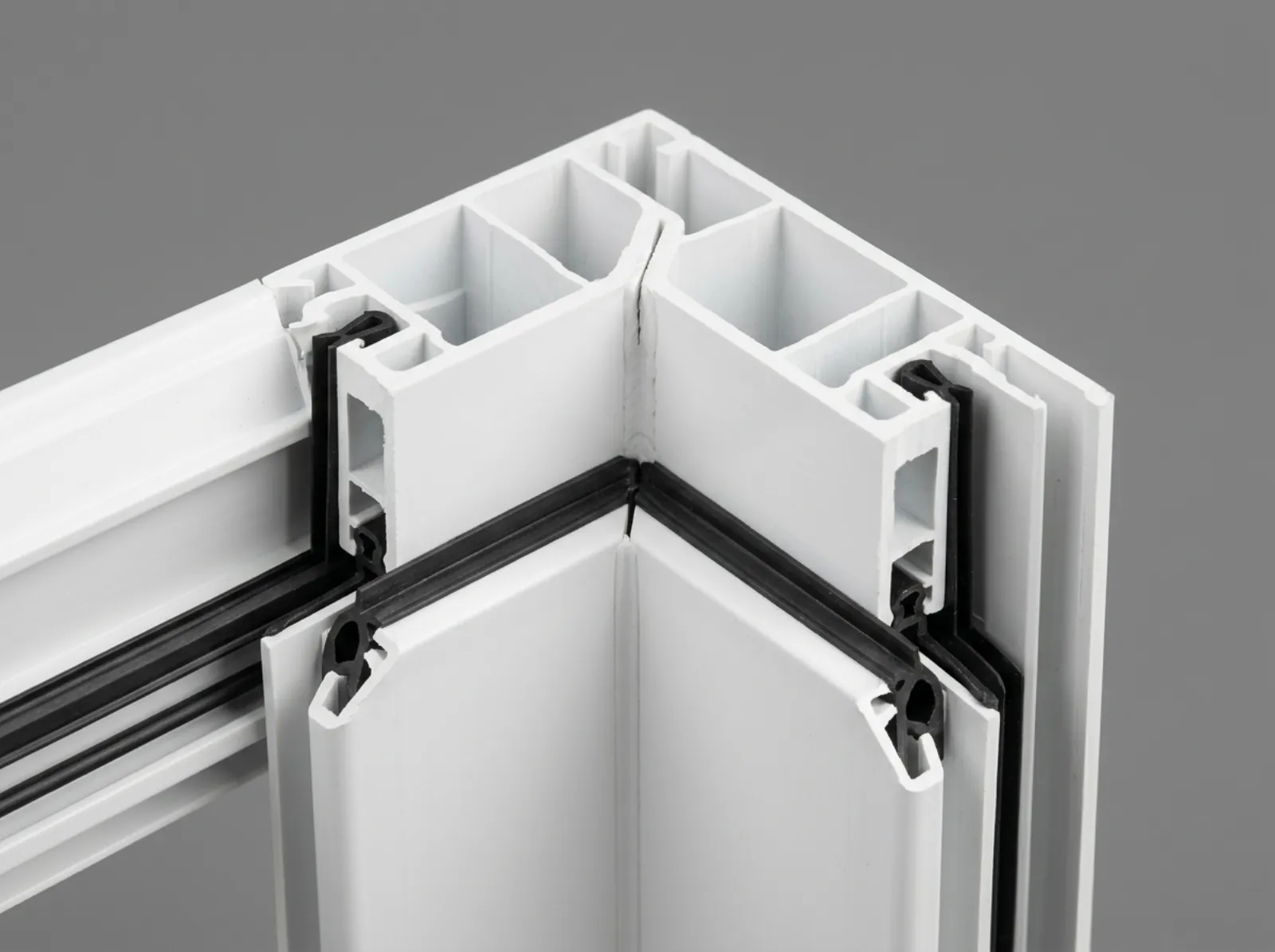
The other reflex is to hear “vinyl” and picture the thin, brittle plastic of a disposable clamshell package or a dollar-store toy. This comparison is just as far off. Rigid uPVC used in windows is an engineered building material, formulated with UV stabilizers, impact modifiers, and additives that give it strength, colour stability, and resistance to weathering. It is extruded into complex hollow profiles with internal walls and chambers, then cut and fusion-welded at the corners into a single continuous frame.
Think of it less like packaging plastic and more like the family of durable rigid PVC products used in serious applications: pressure pipe that carries municipal water, electrical conduit, and exterior siding rated to survive decades of sun and storms. The same base material, engineered and formulated for structural use, behaves nothing like the flimsy stuff people picture. Calling a uPVC window “just plastic” is a bit like calling a carbon-fibre bicycle frame “just glue and string.” Technically there is a kernel of truth in the raw ingredients, but it completely misses what engineering does to them.
The chemistry, in plain English
PVC is a polymer — a long chain molecule — built from vinyl chloride units, which are themselves derived from common salt and hydrocarbons. On its own, the polymer is rigid. To make soft products, manufacturers add plasticizers; to make window frames, they leave those out and instead add ingredients that enhance rigidity, impact resistance, and long-term stability in sunlight. That is the whole trick behind the confusion: the same three letters, P-V-C, describe both the bendy record and the rigid window frame, but the formulations are engineered for opposite goals.
Bottom line: a vinyl window is made of rigid, unplasticized PVC (uPVC) — a hard, engineered, weather-stable building material. It is not soft, it is not linoleum, and it is not the disposable plastic of packaging. Same word, entirely different product.
The Test of Time: Durability and Energy
A window is a long-term purchase. Nobody wants to do this twice in fifteen years, so the real questions are how well vinyl holds up over decades and what it does for comfort and energy costs the entire time it is in the wall. Here is where vinyl earns its reputation.
Durability: what actually happens over the years
The great durability advantage of vinyl is what does not happen to it. It does not rot, because there is no organic material for moisture or fungus to attack. It does not rust or corrode, because it is not metal. It does not need paint, so it cannot peel, blister, or fade the way a painted surface does — the colour is part of the material itself, all the way through, rather than a coating sitting on top. Insects have no interest in it. Moisture does not swell it. These are precisely the failure modes that shorten the life of wood and aluminum windows, and vinyl simply sidesteps them.
That is not to say vinyl is indestructible or entirely without limits, and we would rather you hear the caveats from us. The main enemy of vinyl over the very long term is prolonged ultraviolet exposure, which is why quality frames are formulated with UV stabilizers; cheaper, poorly formulated vinyl from decades ago sometimes yellowed or grew brittle, but modern reputable profiles are engineered specifically to resist this. Vinyl also expands and contracts slightly with temperature more than some materials, which is one reason professional installation and proper sealing matter — the system is designed to accommodate that movement. And very dark exterior colours absorb more heat, so colour choices on large sun-facing windows are worth discussing rather than treating as purely cosmetic.
With those caveats noted, the real-world track record is excellent. A well-made vinyl window, properly installed, routinely delivers thirty to forty years of service, and many carry a transferable limited lifetime warranty on the frame precisely because manufacturers are confident in that longevity. Maintenance amounts to washing the frames and glass a couple of times a year, keeping the drainage weep holes clear, and occasionally lubricating the hardware. Compare that to the sanding, priming, and repainting cycle of wood, and the appeal is obvious.
Failure modes vinyl sidesteps
Typical service life
Energy performance: comfort you can feel and measure
Durability keeps a window in the wall; energy performance is what it does while it is there. And this is arguably the single strongest argument for modern vinyl windows. The frame is only part of the story, but it is an important part: because vinyl is a poor conductor of heat and the frame is built as a series of hollow, sealed air chambers, it acts as a natural insulator. Those internal chambers trap air and interrupt the path that heat would otherwise take through the frame, which is exactly the opposite of what an aluminum frame does.
The bigger energy player is the glass, which we cover in detail in the next section, but frame and glass work as a system. A high-performance sealed glass unit set into a leaky, conductive frame is a wasted opportunity; a well-insulated vinyl frame lets the glass do its job. Together, a modern vinyl window with Low-E coatings and argon gas fill can dramatically reduce the heat that escapes in winter and the solar heat that pushes in during summer.
A window works as a system
Three parts combine to cut the heat your home loses and gains.
Insulated frame
Hollow, sealed vinyl chambers trap air and block the heat path through the frame.
Low-E glass
A microscopic coating reflects radiant heat — keeping warmth in during winter and solar heat out in summer.
Argon gas fill
Dense, inert gas between the panes slows heat transfer far better than plain air.
For an Ontario home, this shows up in three ways you actually notice. First, comfort: no more cold zone you can feel radiating off the window on a January night, and no more rooms that overheat in July afternoon sun. Second, condensation: warmer interior glass surfaces are far less prone to the fogging and dripping that plagues old windows and can damage sills and drywall over time. Third, cost: while exact savings depend on your home, your old windows, and your habits, replacing genuinely inefficient windows with modern sealed units typically trims heating and cooling bills noticeably, every single month, for the life of the window.
A useful way to think about it: the frame material determines how little heat leaks through the frame, and the glass package determines how the window handles radiant heat and light. Vinyl wins on the first count and gets out of the glass’s way on the second. That combination is why it became the energy-efficiency default.
One practical note worth knowing: in Canada, look for the ENERGY STAR® mark and the rating information on the window. These ratings tell you how the whole unit performs for our climate zone, which is a far more reliable guide than any single marketing claim about the frame or the glass in isolation. The windows we supply meet or exceed those standards for our region.
A realistic maintenance routine
People sometimes hear "maintenance-free" and picture a window they never have to touch again. That is close, but not quite honest, so here is the real version. Vinyl frames never need painting, sanding, or sealing, which is where the vast majority of a wood window's upkeep used to go. What they do benefit from is a light seasonal once-over. Twice a year, wash the frames and glass with mild soap and water — nothing abrasive and no harsh solvents, which can dull the surface. While you are there, wipe out the sill track and vacuum any grit that has collected in the corners, because debris is the number one cause of a sash that starts to feel stiff.
The one component most homeowners overlook is the weep system: the small drainage slots along the bottom of the exterior frame that let rainwater escape instead of pooling inside the track. Keep those clear with a soft brush or a quick puff of air once or twice a year and your window will shed water exactly as designed. A drop of silicone-based lubricant on the moving hardware — locks, hinges, and rollers — every year or two keeps everything operating smoothly. That is genuinely the entire list. Ten minutes per window, twice a year, and a quality vinyl unit will keep doing its job for decades.
Anatomy: Casings, Frames, and Panels
To make a genuinely informed choice, it helps to know what you are actually looking at. A window is not a single object — it is an assembly of parts that each do a specific job. Let us walk through the three that matter most: the frame, the casing and trim, and the glass panels.
The frame and its chambers
The frame is the structural perimeter of the window, and in a vinyl unit it is where a lot of the quiet engineering lives. If you were to cut through a quality vinyl frame and look at the cross-section, you would not see a solid slab of plastic. You would see a series of hollow compartments separated by internal walls — these are the chambers. More and better-designed chambers generally mean better insulation and greater rigidity, because each sealed pocket of still air resists heat transfer and each internal wall adds stiffness.
The corners of a quality vinyl frame are fusion-welded, not screwed or glued. During manufacture the cut ends of the profile are heated until the material softens and then pressed together, fusing into a single continuous piece as they cool. This matters more than it sounds: a welded corner has no mechanical joint to loosen, no seam for air or water to sneak through, and no fastener to corrode. It is one of the clearest markers separating a well-made vinyl window from a cheap one.
Some vinyl frames also include internal reinforcement — metal or composite stiffeners inside certain chambers — on larger units or specific styles where extra structural strength is needed. That is a normal, sensible part of the engineering, not a sign that vinyl alone is inadequate; it simply matches the frame to the span and load.
Casings, trim, and how the window meets your wall
People often use “frame” and “casing” loosely, so let us separate them. The frame is the window’s own structural border. The casing and trim are the finishing pieces that cover and seal the transition between the window and the surrounding wall — the interior trim you see from inside, and the exterior trim, brickmould, or capping that weatherproofs the joint outside.
This transition zone is where a surprising amount of a window’s real-world performance is won or lost. A superb window installed with sloppy trim and poor sealing around the perimeter will still let in drafts and water, because air and moisture do not care how good the unit is if there is a gap beside it. Good installation includes proper insulation of the gap between frame and rough opening, a continuous air seal, and exterior detailing that sheds water away from the joint. On the exterior, aluminum capping is often used to wrap exposed wood trim so that it, too, becomes maintenance-free and weather-tight.
When you evaluate a window replacement, it is worth asking not just about the window but about how the opening will be finished and sealed. That detail work is invisible once it is done well and painfully obvious when it is done badly.
The glass: double-pane versus triple-pane
The glass — more accurately, the insulated glass unit, or IGU — is the heart of the window’s energy performance. A modern IGU is not a single sheet of glass. It is two or three panes separated by a spacer and sealed around the edge, with the space between the panes filled with an inert gas, usually argon, that insulates better than ordinary air. The panes typically carry a Low-E (low-emissivity) coating: a microscopically thin metallic layer that reflects heat back toward its source — keeping warmth inside during winter and reflecting solar heat away during summer — while still letting visible light pass through.
A double-pane unit has two panes and one insulating gas-filled space. This is the standard, and for many homes and many openings it is genuinely all you need — it is a massive upgrade over single-pane glass and performs very well.
A triple-pane unit adds a third pane and a second gas-filled space. The benefits are additive: better insulation against heat loss, better resistance to condensation on the coldest nights, and notably better sound dampening, which is why triple-pane is popular for homes near busy roads or for bedrooms where quiet matters. The trade-offs are honest ones: triple-pane units cost more and weigh more, and the incremental energy gain over a good double-pane Low-E argon unit, while real, is smaller than the leap from single to double. Whether the upgrade is worth it depends on your priorities — noise, extreme comfort, and long-term efficiency versus upfront cost.
Double-pane
2 panesOne insulating gas chamber
The efficient standard for most homes.
Triple-pane
3 panesTwo insulating gas chambers
Best for noise, harsh exposures & top efficiency.
- Single-pane (old windows): one sheet of glass, essentially no insulation — the thing you are almost certainly replacing.
- Double-pane Low-E argon: the modern standard; excellent efficiency and comfort for most homes and openings.
- Triple-pane Low-E argon: top-tier insulation and sound control; best for noise-prone locations, harsh exposures, or maximum efficiency — at higher cost and weight.
It is also worth understanding the spacer — the strip around the perimeter that holds the two or three panes apart and seals the gas inside. Older units used simple aluminum spacers, which conduct cold straight to the edge of the glass and are a common spot for condensation to form first. Modern “warm-edge” spacers use less-conductive materials to keep the glass edge warmer, improving both comfort and the long-term life of the seal. When the edge seal eventually fails on any insulated unit — which is what causes that permanent fog trapped between the panes — the whole sealed unit has to be replaced, so the quality of that spacer and seal genuinely matters over the decades.
Beyond pane count, glass can be specified for particular needs: obscure or frosted glass for bathroom privacy, tempered safety glass where code requires it (near doors, low to the floor, or by stairs), laminated glass for extra security and sound reduction, and decorative grille patterns if you want a traditional colonial or prairie look. These are choices made opening by opening, which is one of the advantages of custom-ordered windows — you are not forced into a one-size compromise.
Installation and DIY: What You Can and Cannot Do
We will be candid here, because this is the section where good intentions most often meet expensive mistakes. Window installation looks straightforward on a video and is genuinely one of the least forgiving jobs in home improvement. That does not mean a capable homeowner can do nothing — it means knowing where the line is.
What a professional installation actually involves
A proper replacement is a sequence of precise steps. It starts long before installation day, with accurate measurement of each opening — not one measurement, but several per opening, because rough openings are rarely perfectly square and the window has to be ordered to fit the real dimensions with the correct allowances. Because each unit is custom-built to those numbers, a measuring error is not a quick fix; it means a wrong window and weeks of delay.
On installation day, the old window comes out, the opening is inspected and prepared, and the new unit is set level, plumb, and square — shimmed carefully so the frame is not twisted or bowed, because a frame forced out of square will not seal and its sashes will not operate smoothly. Then comes the part that separates a lasting installation from a callback: insulating the gap around the frame without over-packing it, establishing a continuous air seal, and detailing the exterior so water is directed away from the joint. Finally the trim and any capping go on, the operation is tested, and everything is cleaned up. Done right, one window at a time, the house is never left exposed for long and each opening is fully sealed before moving on.
It is also useful to know the timeline so there are no surprises. After you accept a quote and the openings are measured for the order, the custom windows are manufactured to those exact specifications — typically a few weeks, since nothing is pulled off a shelf. Installation day itself is usually quick: a single window might take an hour or two, and even a whole-home replacement is often finished in one to three days depending on the count. The lead time is in the building of the windows, not the installing of them, which is worth remembering when you are planning around a season or a deadline.
None of these steps is mysterious, but each one has a way it must be done and several ways it can go wrong, and the consequences of getting them wrong — drafts, leaks, seal failure, voided warranty, hard-to-open sashes — show up gradually, long after the job feels finished.
Honest DIY tips — with real caveats
So what can a handy homeowner reasonably take on? Plenty, if you stay on the right side of the line. Here are things that are genuinely DIY-friendly:
- Maintenance and cleaning: washing frames and glass with mild soap and water, and keeping the exterior weep holes (the small drainage slots along the bottom of the frame) clear of dirt and debris so water can escape as designed.
- Hardware care: lubricating cranks, locks, and rollers, and tightening loose handle screws — small tasks that keep everything operating smoothly for years.
- Weatherstripping touch-ups: replacing worn weatherstripping on an existing window is often a manageable job that noticeably cuts drafts.
- Interior caulking refresh: re-running a tidy bead of interior caulk where trim meets wall can improve both looks and the air seal.
- Assessment and planning: measuring your openings for a rough budget, documenting problem windows, and learning enough to ask installers good questions.
And here is where we would gently but firmly recommend caution — the parts of the job where DIY most often turns into an expensive lesson:
- Final measuring for a custom order: an error of even a small amount can produce a window that does not fit; professionals measure this way for a living because the cost of being wrong is so high.
- Removing and setting the unit: getting a frame level, plumb, and square — and properly shimmed so it is not twisted — is deceptively difficult and determines whether the window seals and operates correctly.
- Air sealing and insulating the perimeter: over-packing expanding foam can bow the frame; under-sealing leaves drafts and leak paths. There is a right amount and a right product, and it is not obvious.
- Exterior water detailing and flashing: this is the step that prevents leaks inside your wall, and mistakes here can cause hidden moisture damage that costs far more than the window.
- Anything involving warranty or heights: many manufacturer warranties depend on professional installation, and second-storey or large, heavy units introduce real safety risks.
Our honest rule of thumb: maintain, clean, adjust, and plan yourself with confidence — but for measuring, removal, setting, sealing, and exterior detailing on a custom-ordered window, the money you might save doing it yourself is usually smaller than the money you risk if it goes wrong. This is one of the few home projects where the install matters as much as the product.
That is not us protecting our trade for its own sake — it is that we have been called in to fix enough well-meaning DIY installations to know exactly how they fail. If you do decide to hire out the work, the single best thing you can do is choose an installer who does their own installations rather than subcontracting, so one team is accountable for the whole result.
Final Thoughts
If you have read this far, you now know more about vinyl windows than the vast majority of people who buy them. You know where the material came from and why it displaced wood and aluminum for most homes. You know that “vinyl” in a window means rigid, engineered uPVC — not something soft, not linoleum, and not disposable plastic. You know how it holds up over decades, how the frame and glass work together to save energy, what is actually inside the frame and the sealed glass unit, and where the sensible boundary sits between do-it-yourself and hire-a-pro.
None of that requires you to buy anything from anyone. Good information stands on its own, and a well-informed homeowner makes better decisions and asks sharper questions — which is genuinely all we set out to help with here. Whether you are years away from replacing a window or staring at a foggy pane right now, we hope this guide made the subject clearer and a little less intimidating.
And if a question comes up that this article did not answer, that is exactly the kind of thing we are happy to talk through — no pressure and no obligation. Whether the answer sends you our way or simply helps you take better care of the windows you already have, understanding your options is the whole point, and it is time well spent either way.